In the autumn of 2024, I started thinking about a possible trip in early 2025. Somehow, for several years now, I’ve established a habit of going on a longer trip precisely during this time of year. There had been various destinations, but then I realised that there was a direct flight from Belgrade to Guangzhou in southern China. Although I didn’t know anything about that part of China, it occurred to me that it would be really great to take advantage of the direct flight. That’s relatively rare when it comes to Belgrade and intercontinental flights, and I had only travelled to a couple of such destinations (a long time ago to New York and back, as well as to Dubai and back). Of course, there were other destinations too, but somehow we never fitted together well – I mean, those destinations and I.
This time I thought it would be good to correct such an "injustice," so I started thinking more seriously in that direction and checking prices. And so I made the decision, but I had to wait to buy the ticket because I needed some (financial) circumstances to align. While I was waiting, I stumbled upon an unbelievably fantastic offer, some sort of unclear promotion to me, but not on the airline’s website – rather on some international sites. The price was so good that I had serious doubts, but in the end I decided to go for it and bought a ticket that, at that moment, cost less than half the price listed on the official website of the airline. I had never scored such a deal in my life, but I still had a nagging doubt even though everything seemed normal – I received both a ticket number and a reservation code. Everything was exactly as it should be. A few weeks later, I checked the website and saw that everything was perfectly in order. I had no idea what had happened, but it wasn’t up to me to complain – just to accept the “gift.”
As is usually the case with me, I didn’t have much free time before the trip, so I didn’t really plan it out thoroughly, nor did I deal with any (important) details. I only came up with the “boundaries” or, more precisely, the general outlines of the regions I was interested in, and I booked a hotel in Guangzhou for the first few days, with the idea of figuring out the rest on the spot.
My experience in Thailand helped me a bit with this decision and just as I was preparing to set off on a trip through southern and south-western China, I was publishing blog posts from my travels through that Southeast Asian country, which reminded me of the system I used back then – apart from the first five days in Bangkok, I moved every other day, and that’s how I booked the accommodation – only for the next couple of days. And all of that worked very well, so I thought I might do the same in China, though I would still need to see on the ground how realistic and doable my idea was.
A very important detail about this trip is that I was there for three weeks and what I ended up visiting during that time can be seen on the following map:
So, I left Belgrade late one evening (after midnight) and according to the flight schedule, I was supposed to land at the international airport in Guangzhou around 7 p.m. the same day. By the way, the time difference between Guangzhou and Belgrade (Central European Time) is 7 hours, so when it’s noon in Central Europe (Berlin, Paris, Rome), it’s already 7 p.m. in Guangzhou.
My plan was to try to buy a Chinese SIM card right at the airport so I would have internet access throughout the trip and for that I also needed to exchange some money (also at the airport).
As for getting to the hotel, although there is an excellent metro system, one of the lines even goes to the airport, based on what I had read online, I concluded that it would still be best to take a taxi. In January 2025, taxis were cheaper than in Belgrade, but I needed to have the hotel name and address written in Chinese, since taxi drivers in Guangzhou typically don’t speak English. No problem; I asked the hotel to send me the text in Chinese, printed it out, and took it with me.
So, I was ready.
I landed in Guangzhou on time and everything at the airport went smoothly, including exchanging some money, just enough for basic needs, and buying a SIM card for my phone. During the taxi ride to the hotel, everything worked as it should.
After settling into the hotel, I went out for a short walk around the neighbourhood because I needed to grab something to eat, and the hotel only offered breakfast.
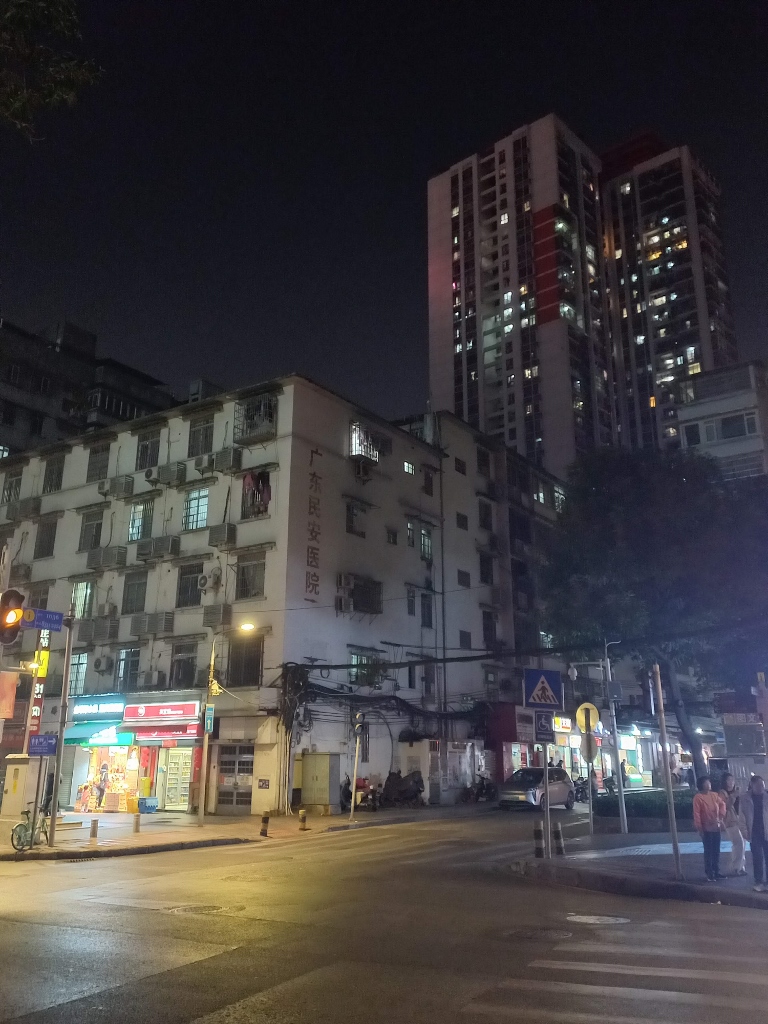 Surroundings of my hotel in Guangzhou
There were several places where I could eat and I chose one of them. Using a phone app, I “translated” the menu and ordered some kind of soup.
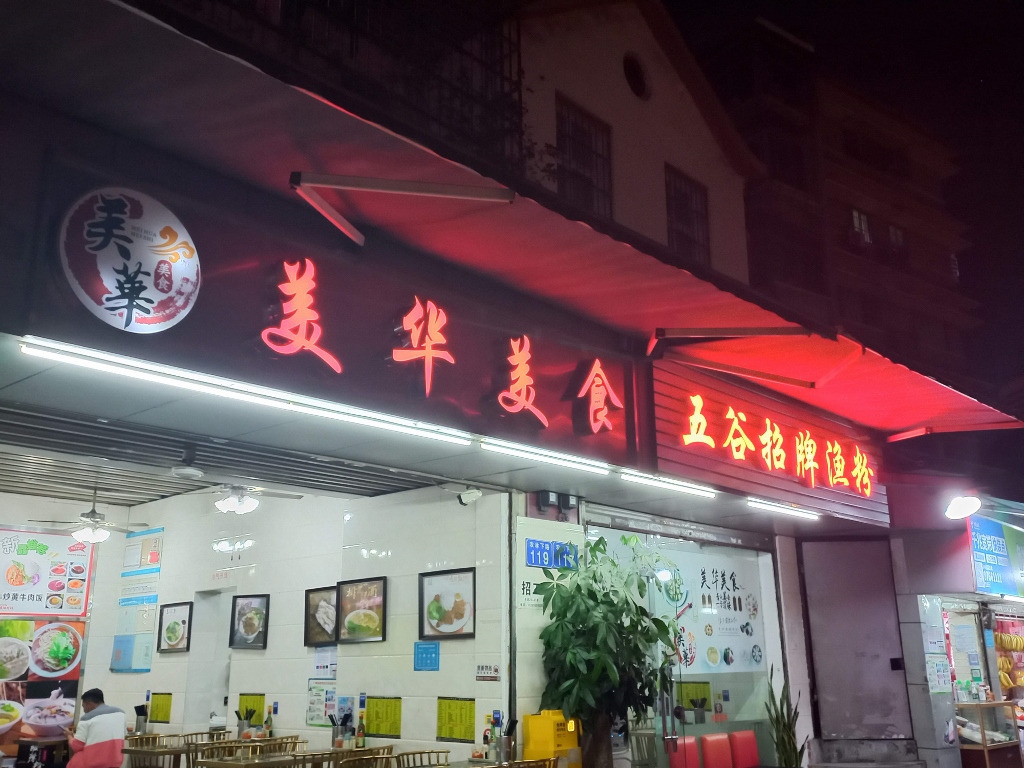 Place where I ate the first evening
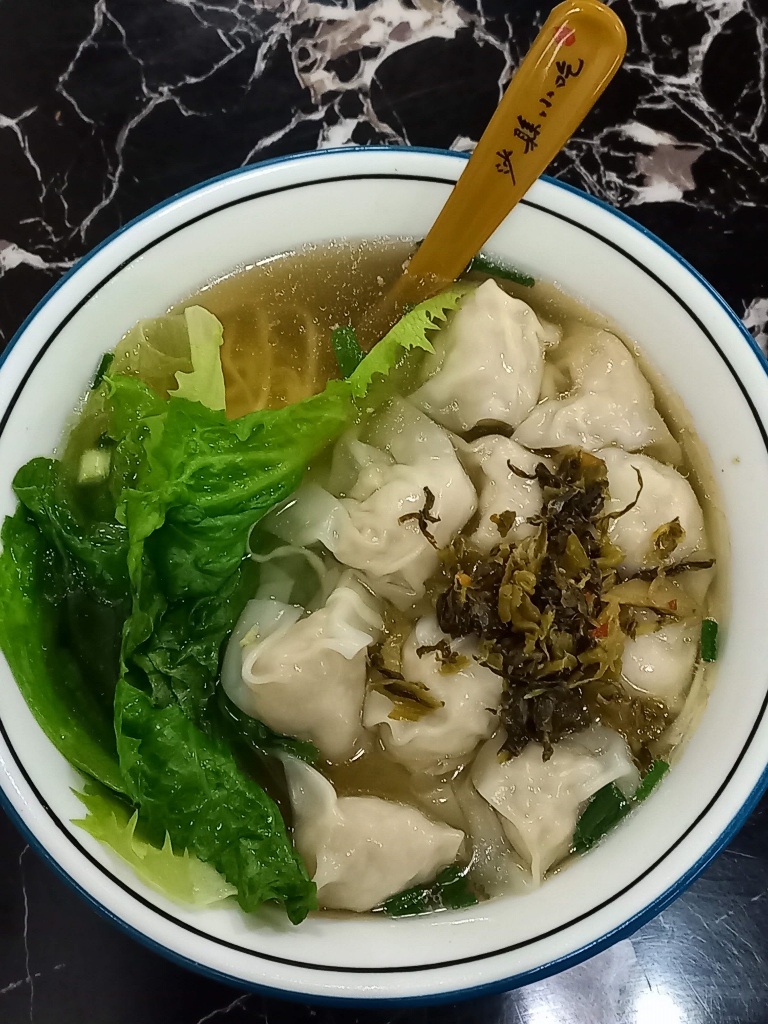 Wonton soup
While I was genuinely enjoying the delicious soup, my mobile phone stopped working – in the sense that it had no internet connection at all. I thought maybe the SIM card was useless, so I patiently finished my soup and went back to the hotel, where I connected to the hotel Wi-Fi. The situation was the same. At first, I was completely confused and then I realised that at least I could use Viber to send a message to family and friends letting them know I had arrived safely. Photos wouldn’t go through.
That’s when I realised the real issue was with Google and you simply can’t access it while in China, and everything I do is somehow tied to that search engine. I couldn’t even view my own blog on the phone.
As a result, I became quite worried, but I comforted myself with the thought that I’d somehow resolve it all the next day.
At some point, I went to bed, and at first it was pretty rough, I dozed off, then woke up a few times. Eventually, I managed to fall asleep properly, but I woke up already around 8 a.m. and got up right away. I just didn’t want to let the jet lag take control.
I went down to the front desk and asked if they had a technician, and they advised me to take the metro two stops from the hotel. Apparently, there I could find a place to ask about resolving the phone and internet issues, and also a place to exchange money. As they told me, at least regarding the second issue (since I wanted to exchange more money), it was Saturday, right before Chinese New Year, and many banks were closed because of it.
I wasn’t quite sure how things would turn out, but I headed to a metro station, which, luckily, was very close to the hotel, so at least that part was easy. At the same time, I was learning the basics of getting around the city and using the metro system. The system is always the same in principle, of course, but there are certain differences in the details. Still, everything went fine and soon I got off at the station the hotel had recommended.
I started looking around and spotted a China Telecom office. Even though I had nothing to do with them (they weren’t even my local provider), I went in and explained that I was having problems with my phone and internet. A very kind woman checked everything on my phone, then called over a young guy who started fiddling with both his phone and mine. All I had to do was sit patiently and wait, which I did.
At some point, the issue was finally resolved, and he installed a VPN app that bypassed the problem of accessing certain platforms. I paid 100 yuan, about 13 euros, and walked back out onto the street, happy and content.
Namely, since I’m a woman now already in my graceful, advanced years, though I’m quite good with digital devices, I’m essentially out of my depth when it comes to things like this. It took me a while to understand that different countries impose certain restrictions on websites, search engines, and so on, usually from other countries that aren’t exactly friendly. Since I don’t do anything secretive in my life and have no hidden agendas, I simply don’t think along those lines. If I use Google Maps, it’s because I’m used to them and because I speak English. If I use certain messaging apps (Viber and WhatsApp), it’s because I’m familiar with them or because my various friends live in countries where one or the other is more popular.
My personal issue with Chinese apps, like maps, for instance, would be that I don’t know Chinese and can’t use such apps meaningfully. And I must admit I wasn’t exactly in the mood to start learning Chinese or how to navigate Chinese apps right there on the spot. Navigating a new country, travelling through it, and getting to know a new culture in the broadest sense was already more than enough of a challenge for me to begin with.
Now that I had resolved the issue with the phone and internet, the next thing was to exchange some money. I didn’t know exactly where to do that, but it seemed like there were more shops on the other side of the street, so I headed that way, only to run into the “problem” of figuring out how to cross. That turned out to be an important lesson. When it comes to big roads, there aren’t pedestrian crossings every 100 meters and you really do have to walk a bit.
As it turned out, in this area, you don’t cross the street at a pedestrian crossing, but via a footbridge. But that gave me the opportunity to observe the city from a bit of a height.
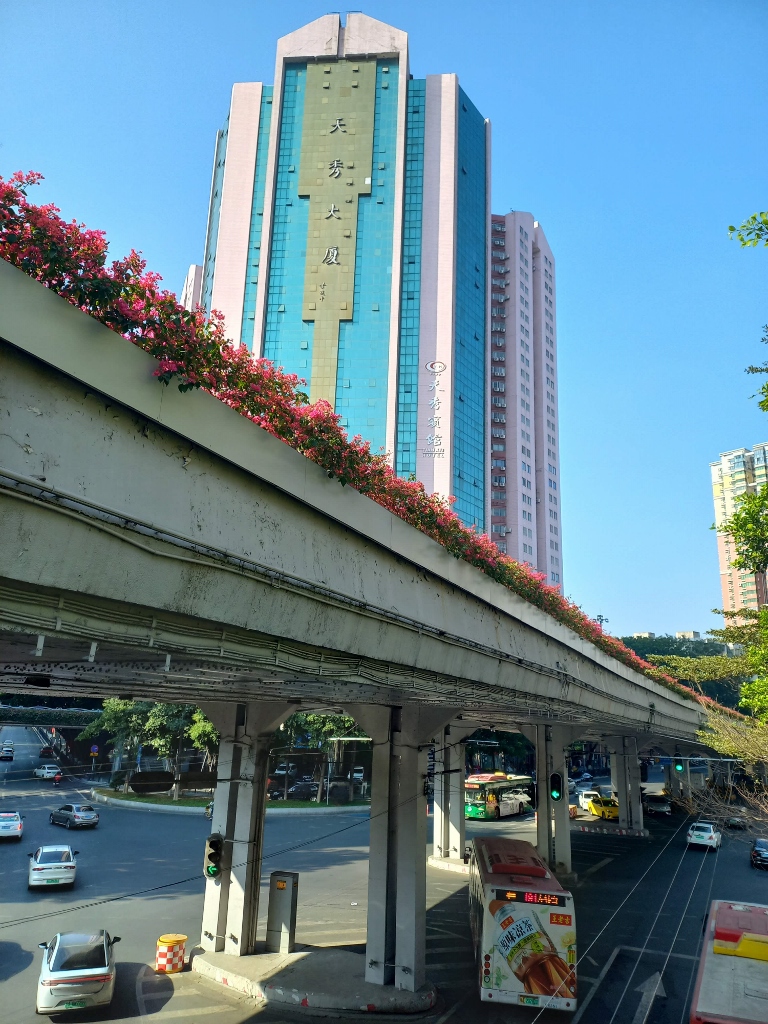 Guangzhou, a detail
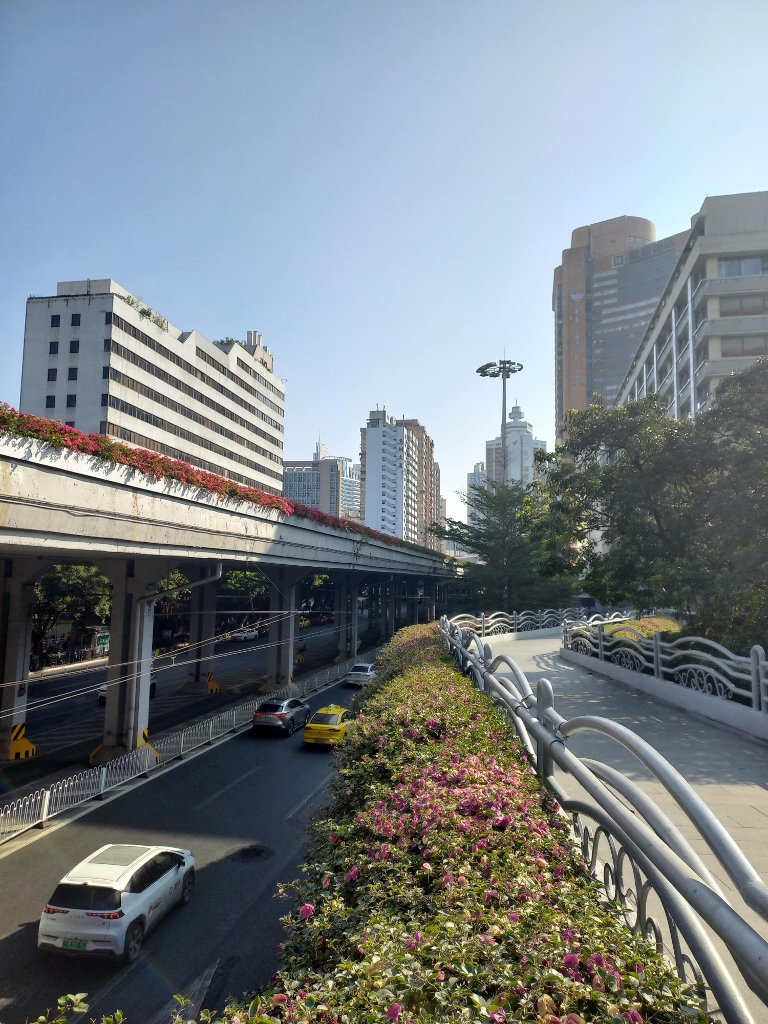 Guangzhou, a detail
Already at this point, I was impressed by the amount of flowers in public spaces and that would only continue throughout the rest of the trip.
In any case, I crossed to the other side and went into a hotel, where I asked where I could exchange money. They directed me to a SIM card shop that also served as a currency exchange office. It seemed to me that the rate was maybe a bit lower than it should be, so I exchanged a smaller amount there and then went to a larger bank, which, as it turned out, was actually open.
However, they didn’t handle currency exchange, so they advised me to go to a large hotel nearby. I didn’t mind walking there and it actually felt good to slowly get a sense of how the city worked and also how my Google Maps was functioning.
I hadn’t been to China before, except for Hong Kong (those stories start here: https://www.svudapodji.com/en/vietnam-1/), but, of course, I was well aware of China’s impressive development in recent years. That’s all very true and quite visible, and I’ll talk more about that in the upcoming sequels. But I’ll mention here that over 18 million people live in the urban area of Guangzhou, which means there are also a lot of vehicles.
Let me say right away that I never saw any horrifying traffic jams and it was clear to me that this was at least partly due to the fact that roads are built on multiple levels, using every bit of available space. Or perhaps new buildings are even being constructed very close to these new roadways?
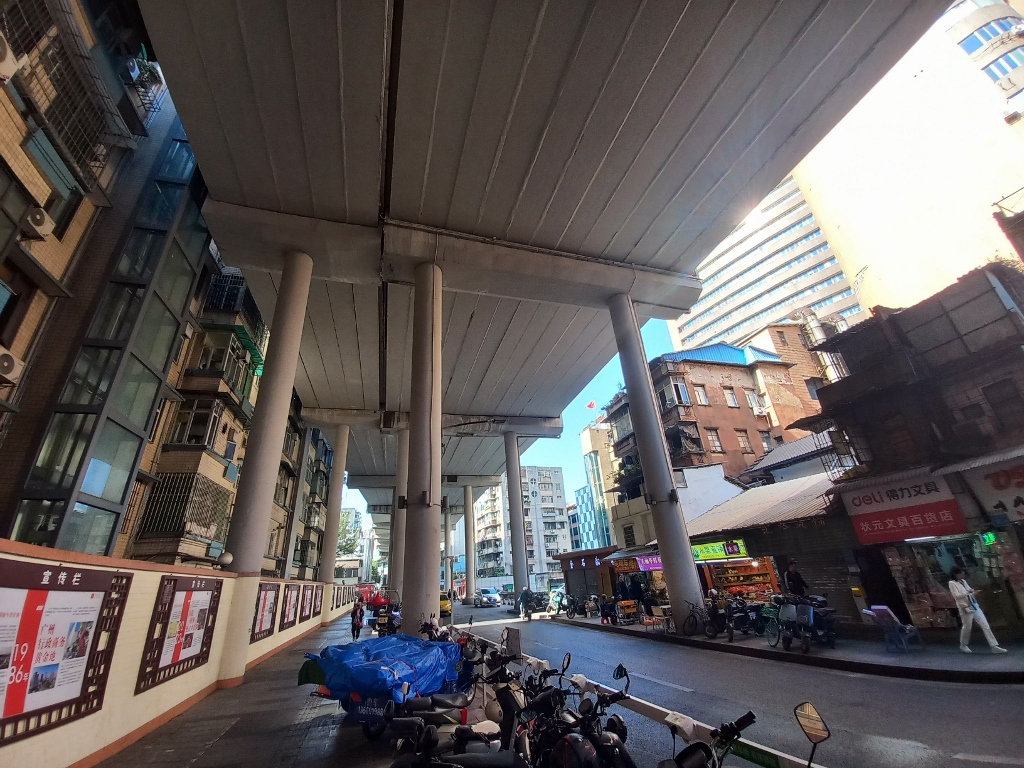 Guangzhou, a detail
Besides that, more and more high-rise buildings are being constructed, presumably because land space is limited, so let’s “build upwards.” But here, just like in Bangkok, Thailand, I noticed another interesting detail. It’s about the grilles installed on balconies – something I had seen before in Bangkok as well. Back then, I thought these grilles were meant to protect against burglars. However, that puzzled me because Thailand didn’t seem like a country with THAT much crime, and the same certainly can’t be said about China.
From what I later found out, there are several reasons for this. On one hand, they serve as protection to prevent small children or pets from falling from great heights. On the other hand, these grilles often effectively “expand” the balcony space, creating extra storage or an extension of the kitchen. They’re also used to hang laundry for drying. There are various other reasons as well, but these seemed like the main ones to me. In any case, some of this can be inferred from the following photo.
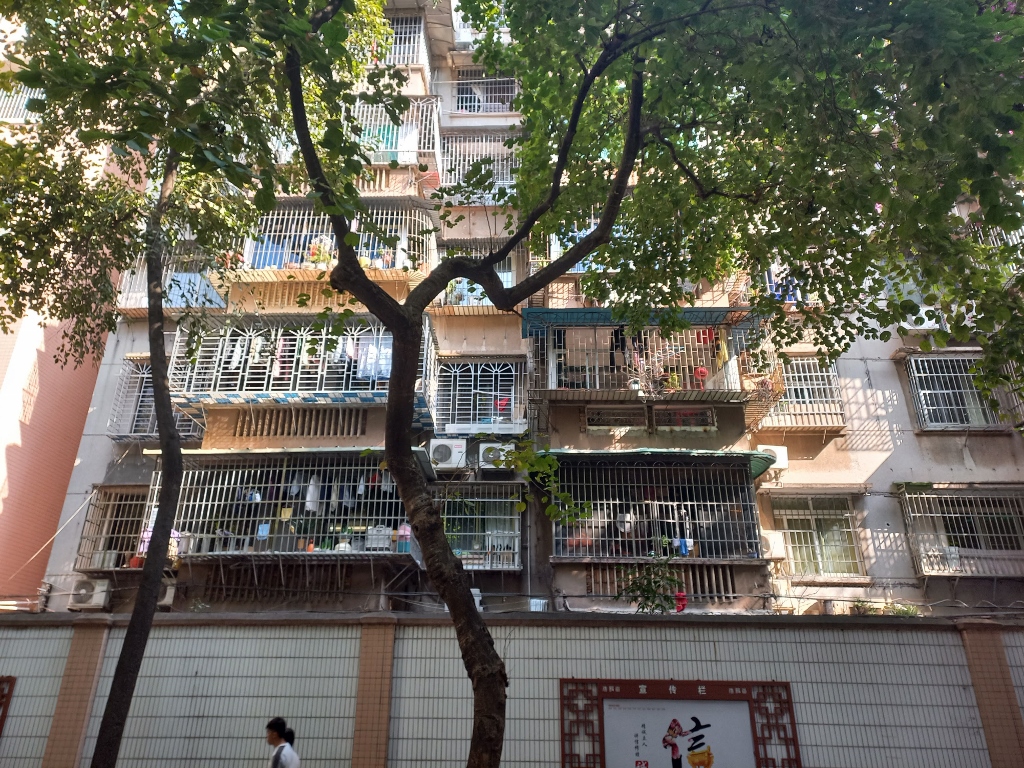 Guangzhou, a detail
During this walk from the bank to the exchange office and beyond, I also started noticing numerous pots filled with mandarin trees heavy with fruit. Curious, I later looked into that and learned that this is a tradition around Chinese New Year for several reasons.
On one hand, the Chinese word for mandarin in some dialects sounds similar to the word for “gold” or “wealth.” Additionally, their golden-orange colour resembles gold coins, while the round shape symbolises completeness, unity, and abundance. All of this, especially during the New Year period, means that these potted mandarin trees, often given as gifts or bought for one’s own home, serve as talismans of luck, wealth, and a good start. In other words, mandarin trees full of fruit in pots are symbols of happiness and a prosperous year, promising to be “fruitful” and successful with the help of this plant.
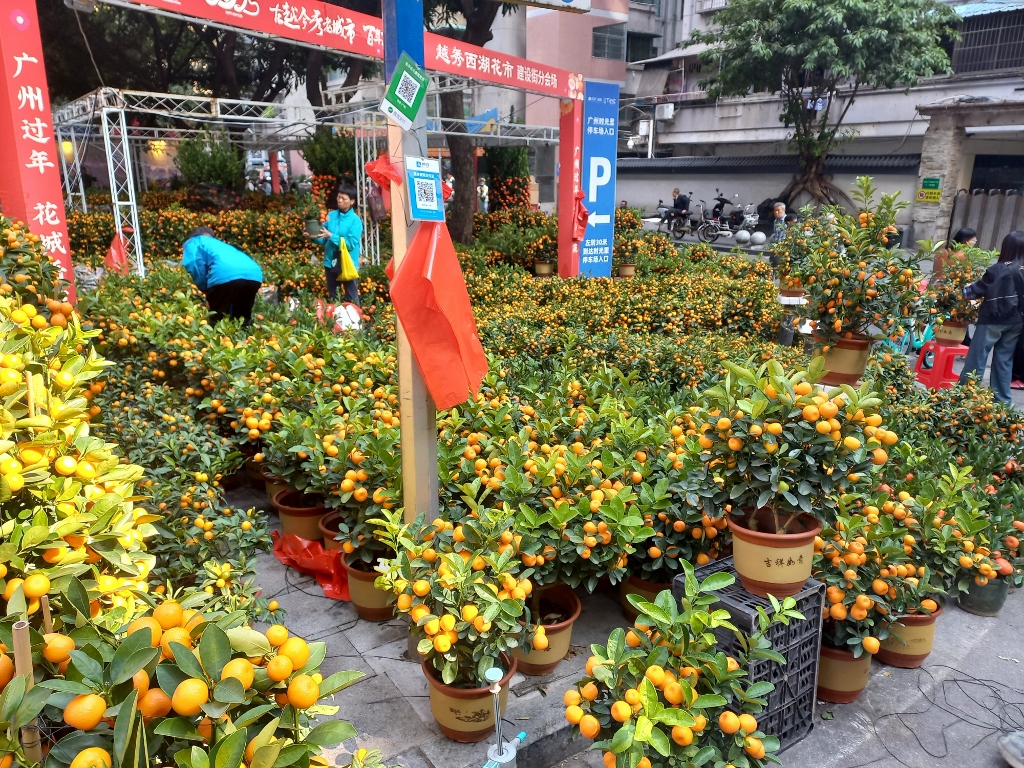 Guangzhou before the Chinese New Year, a detail
And as for me, I kept walking and eventually reached that nice hotel the bank had recommended, but they only had a machine offering a disastrously bad exchange rate. Generally, I’m not too bothered by exchange rates, I don’t exchange large sums anyway, so I wouldn’t be at any big loss. Besides, this was all part of a kind of “fact-finding mission” where I was getting familiar with the nuances of staying in China.
So, I went to a smaller bank I noticed along the way and exchanged the amount I had planned there. The rate was better, though not significantly, but in the end, I got what I wanted.
What struck me as interesting was that the whole procedure took half an hour – no exaggeration. I don’t know what they were typing into the system; I had to sign something at least ten times, but everything went smoothly, except... the phone and the internet. I don’t know what happened, but my phone once again lost access to the sites important for me. So, it actually worked out well that I had been messing around with the currency exchange, because now I nervously went back to the China Telecom office.
The guy was still there and told me I had turned off the VPN, which I definitely hadn’t done, but for some reason, it had happened. Anyway, he turned it back on and showed me how to do it myself if it ever got turned off again.
I told myself I’d have to be twice as careful not to accidentally switch it off because it’s definitely better for me that way.
By this point, I was pretty exhausted, and since the metro station was right there by China Telecom, contrary to my original plans, I decided to return to the hotel to comfortably relax in my room, check my emails, send what I needed, and at the same time figure out which direction to head next.
That’s exactly what I did. I also drank a couple of coffees in my room to wake myself up a bit more, then went back out to the street and headed to the metro. By now, I was completely familiar with the system.
I headed towards the Yuexiu Park station.
While riding the metro and considering different transfer options, I delved deeper into the city metro map and realised that in this way I also figured out where two large and important train stations were located. That was very important for the continuation of the trip I was planning for a few days later.
Once I exited the metro to street level, following some signs, I still couldn’t find a place to cross the street. In any case, I continued south along the same side of the main street where I came out of the metro because that suited me best.
 Guangzhou, a detail
By the way, later I realised that navigating the area around metro stations is actually very easy, but I was probably still under the influence of the time zone changes, so my brain wasn’t working quite right. The important thing is to check the map to see which exit from the metro system suits you best. Each station has at least 2, 3, or 4 exits marked A, B, C, and so on, and these sometimes serve as underground passages (instead of pedestrian crossings on the surface).
Anyway, because of my confusion about which metro exit to take I ended up, completely unplanned for that day, at the Museum of the Mausoleum of the Nanyue King. I hesitated for just a moment, but since I was already there, it seemed silly not to stop by the museum. So that’s what I did.